

Webhook retries are the mechanism of reattempting to deliver webhook events over a specified period, ensuring they eventually reach their destination. Given the inherent unreliability of network connections, retries play a critical role in guaranteeing that events are successfully delivered, even in cases of temporary disruptions. Convoy is a flexible webhook gateway that can be configured to use eitherDocumentation Index
Fetch the complete documentation index at: https://getconvoy.io/docs/llms.txt
Use this file to discover all available pages before exploring further.
linear or exponential backoff retry strategy.
Comparing Retry Algorithms for Webhooks
Retry algorithms aren’t specific to webhooks, rather they’re a general technique used to solve various problems in distributed systems. But what would be appropriate retry configuration for a webhook provider? Most providers offer retries with exponential backoff. Let’s assess three retry strategies for webhooksLinear RetryExponential BackoffExponential Backoff with capped duration
- Requirement 1: The first 5 retries should happen in less than 30 minutes.
- Requirement 2: The maximum retry should not exceed 24 hours.
| Strategy | Formula |
|---|---|
| Linear Retry | + 1 hour |
| Exponential Backoff | (delaySeconds * 2^attempt) + jitter |
| Exponential Backoff with Capped Duration | min(delaySeconds * 2^attempt, maxRetrySeconds) + jitter |
- Base: 20 seconds
- Jitter: +/-10%
- Delay Growth:
delaySeconds * 2^attempt - Retry Limit: 20
- Delay Growth: The delay doubles with each retry attempt, allowing for a rapid increase in wait time for successive failures (
delaySeconds * 2^attempt). - Capping: The new strategy incorporates a default (but configurable) cap of 7200 seconds (
maxRetrySeconds) to prevent indefinitely long wait times, thus ensuring the system remains responsive and efficient. - Jitter: A
jittervalue is added to each calculated wait time, providing an additional layer of randomness that further helps distribute the retry attempts over time.
The Results
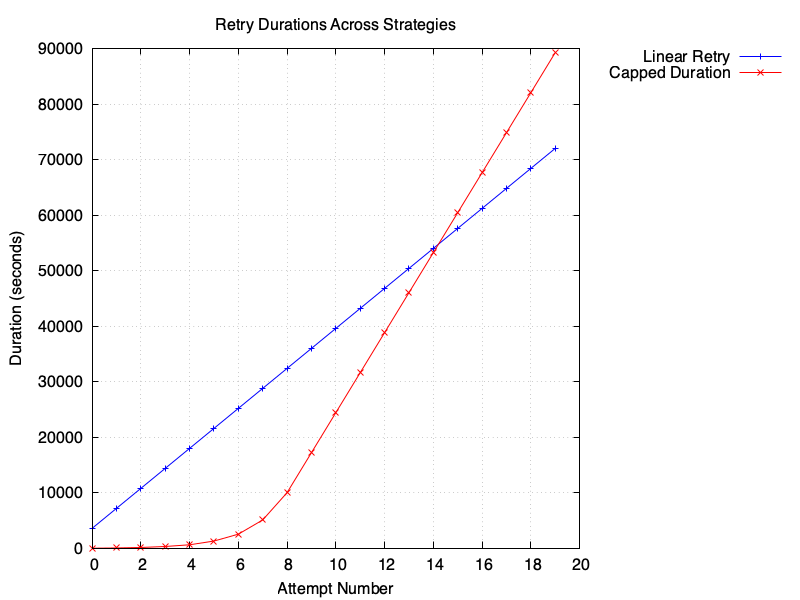
| Linear Retry | Exponential Backoff with Capped Duration | |
|---|---|---|
| Requirement 1 The first 5 retries should happen in less than 30 minutes | The graph shows that the linear retry strategy takes about 18,000 seconds by the 5th retry. 18,000 seconds is approximately 5 hours, which exceeds the 30-minute limit for the first 5 retries. | The graph shows that the capped duration strategy takes about 601 seconds by the 5th retry. 601 seconds is approximately 10 minutes and 1 second, which doesn’t exceed the 30-minute limit for the first 5 retries. |
| Requirement 2 The maximum retry should happen not greater than 24 hours | By the 20th retry attempt, the linear strategy takes about 72,000 seconds, which translates to 20 hours, which doesn’t exceed the 24 hours rule. | By the 20th retry attempt the capped duration strategy takes about 89559 seconds, which translates to 24 hours 52 minutes which slightly exceeds the 24 hours rule. |
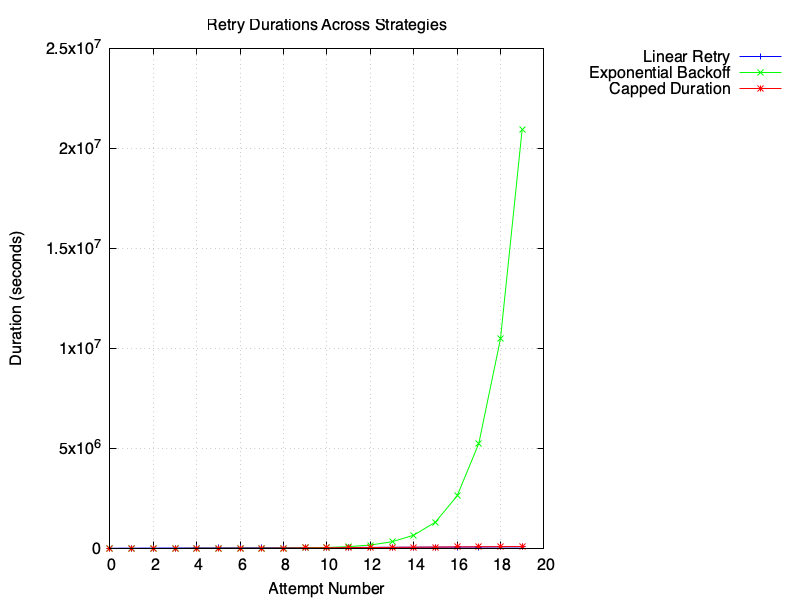
Appendix
- These numbers aren’t a hard and fast rule; rather, they’re a framework for reasoning about the latency requirements for your webhooks and tuning them accordingly. This would optimize your entire delivery process and save $$$ in compute. Feel free to use our script - compare-retries.
🇺🇸 US Region
Access Convoy Cloud US region
🇪🇺 EU Region
Access Convoy Cloud EU region